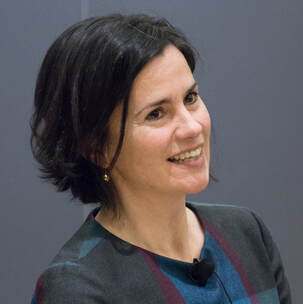
Photo: Edmond J. Safra Center for Ethics
|
I joined the NYU Philosophy Department in 2022, where I am a Julius Silver Professor and Co-Director of the New York Institute of Philosophy. Previously I was Distinguished Professor at the Graduate Center CUNY (2016-2022), and Professor of Philosophy at the University of Sheffield (2012-2016) where I continue to hold an Honorary Professorship. Prior to that I taught for many years at Birkbeck, University of London.
The two main projects on which I am currently working are both in moral philosophy. The first is Blaming and Forgiving: The Work of Morality (contracted with OUP), and the second, which is in early stages, is Post Script: Bernard Williams' Philosophy of Ethical Freedom. I'm a Fellow of the British Academy, and the American Academy of Arts and Sciences; I serve as moral philosopher on the UK Spoliation Advisory Panel. |
My research generally falls in the subject areas of moral philosophy and social epistemology, though I hope that most of my work might equally be described as feminist philosophy, since feminist perspectives have always been at the heart of what I try to do in philosophy. When I was a student, it was specifically the feminist philosophical work that I read while doing an interdisciplinary MA in Women’s Studies at the University of Kent, Canterbury (1989-90) that brought me back to graduate study in philosophy. I subsequently completed my DPhil at Oxford in 1996 having had the double good fortune of being co-supervised by Sabina Lovibond and Bernard Williams, both of whose work was for me then, and continues to be now, a guiding light for which I am ever more grateful as the years go by. An interest in the significance of social identity and power in all kinds of human practices continues to drive my work, and it tends to lead me to the border territories that lie between epistemology and moral philosophy. Most recently I have been drawn, in social epistemology, to questions of how epistemic virtues and vices can become embedded in institutional bodies; and also, in ethics, to our interpersonal moral psychological responses of blaming, apologising, and forgiving. In this latter connection, I am exploring the idea that we should nurture only those responses that promote shared moral understandings of the behaviour concerned.
Here's a recent 60-minute interview on Swiss National Television (SRF) Sternstunde Philosophie;; an item in Die Zeit on the occasion of the German translation of Epistemic Injustice (Epistemische Ungerechtigkeit, 2023, C. H. Beck);
and a Five Questions podcast interview with Kieran Setiya
Here's a recent 60-minute interview on Swiss National Television (SRF) Sternstunde Philosophie;; an item in Die Zeit on the occasion of the German translation of Epistemic Injustice (Epistemische Ungerechtigkeit, 2023, C. H. Beck);
and a Five Questions podcast interview with Kieran Setiya